Showing posts with label Blog Post. Show all posts

Saturday, June 25, 2016

Blog Post: Porth Yr Ogof - Diving and Data. By Christine Grosart, Project Manager. 25th June 2016


     Porth Yr Ogof


An extremely busy year for both Rich and I meant that getting over to Porth this year was looking impossible, until I spotted a window of opportunity on a Saturday afternoon.
Of course, that means lining up the weather too and I kept a close eye on the Environment Agency River Levels Data website, which records the levels of the Mellte at regular intervals. Despite sporadic heavy showers, the water level in Tradesman's Entrance Station 3 was anecdotally low, the distance between the water surface and the top of the 'flat ledge' on the right being 64cm.


I decided to dive first and do the other data recordings at the other sites later. Kitting up in the car park, there were several mini buses of children going caving. I slid down to the water and to my horror, my go-pro 'pinged' from its string which had been tied to a bolt-snap and D-ring and vanished into the bubbling water.
Porth is notorious for eating dive gear, often dropped in the entrance and it is taken away by the fast flowing water, never to be seen again. I should have known better and put the go-pro in a pocket - but, furious with myself for not taking my own advice, continued with the dive in any case.
Standard photo of Tradesman's Entrance
Station 3

The flow in the entrance was moderate. I spotted 2 medium size trout which were pale in colour but not completely white, close to the first couple of tie-offs. I didn't have a helmet or helmet mounted lights, but used instead a Halcyon Focus hand held torch and back ups mounted on my harness. 
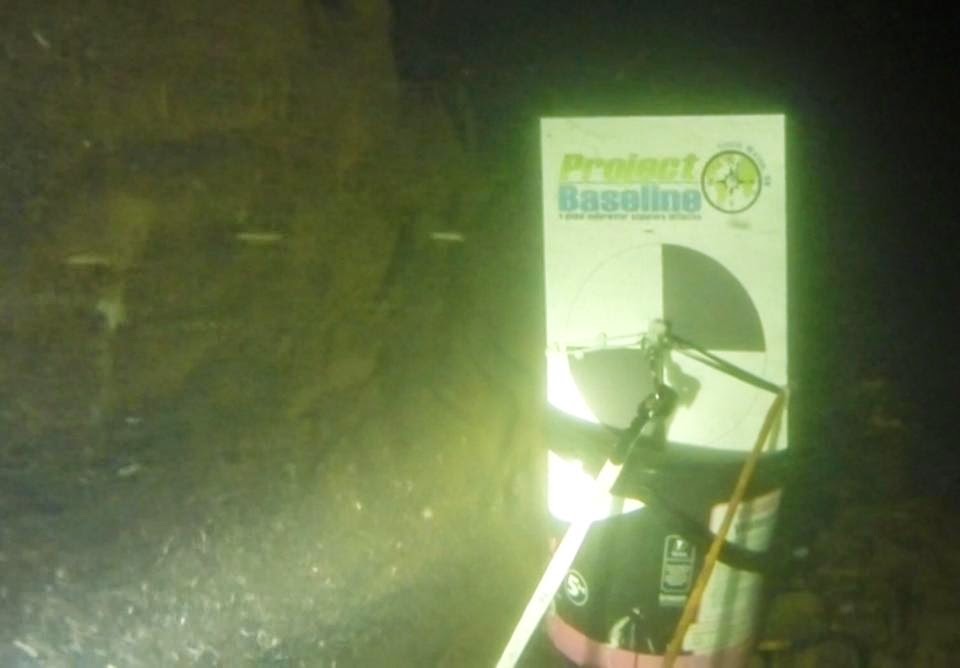
As I approached the Secci disc, I stopped so that I didn't disturb the visibility ahead.
The line is tagged with red cable ties at 50cm intervals so I put the focus onto a fairly tight beam and could just about make out the secci markings from exactly 5m away, counting the tags as I moved forward.
The depth of the Secci was 2.9m and the water temp was recorded as 13 degrees C.
I noted some detritus starting to form on the face of the secci, despite it facing downstream.
I continued upstream, noting some larger, whiter trout and 3 bullheads, one of which was grubbing around in the silt.
River Levels data. Standard image of Station 6.
There was a thick layer of silt on the normally clean washed passage floor and the viz seemed gloomy to me, with lots of particles in suspension.
I then approached the 'Pot' which has been neatly re-lined by Max Fisher, with a rope protector in situ, doing it's job to stop the line fraying over the edge of the pot.
This seems the way forward as I don't see much value in damaging the cave further by putting in a bolt for this purpose.
The flow seemed to get a little stronger as I continued upstream, possibly due to recent bursts of rain which may have started to make their way into the cave. As I got to the cobble slope which surfaces in Upper Cave Water Chamber, I was shoved quite violently down the tube and decided to turn around - which took some doing - as the flow was definitely getting stronger.
Children on their caving trips
I had the usual low viz roller coaster ride home and once de-kitted in the car park, headed back into the cave to look for my Go-Pro which I luckily found just behind the water entry spot, pinned to a rock by the high flow.
It was already past 4pm so I elected not to dive again but instead visit the other stations to take standard photos of each station and water temperature readings where I could.
It's a pleasant job to wander down to Main entrance (station 4) and sit in the tranquility once the cavers have gone home. I spotted a small brown fish darting around in the entrance pool - and one welly boot!
It's a short walk down to the resurgence where I took a temperature reading with my D-Timer and also up to Top entrance where there were some really pretty wild flowers growing. 
Back up the steps, a grey squirrel was busy running around the tree trunk. 


PB data sheets as an aide memoire
Depth gauge and reel, used for temperature data
Red Campion

Meadow Buttercup
Herb Robert


Friday, April 29, 2016

Blog Post: by Maxwell Fisher. 19th & 26th April 2016


Tuesday the 19th saw me diving at Porth Yr Ogof for the first time in 2016.
I had been monitoring the weather forecasts and River Mellte gauge levels for some time, hoping to get in. Finally time off work and weather aligned and I was able to make a trip over.
The water level was approximately one fin length (Mares Quattro) below the step; steady progress was made along the passage in light to moderate flow. 
Line abrasion from flow in the 'Pot'
The first point of note was the abrasion partway down the first pot. The sheath of the line was worn through, exposing the core which showed some signs of wear. I decided it wasn’t about to break on me anytime soon and continued surfacing in the first airbell. 
A quick check on gas pressures was made before I continued onto the next airbell. Again a quick check on gas pressures was made before continuing onto the upper cave water chamber. 
About 10m before the junction to Esser’s passage, some loose line was billowing down the passage. I continued on and saw that it was coming from the pot leading down to the rest of the cave. I continued along the main line and surfaced in the upper cave water chamber, the boulder slope easily passed in a wetsuit and 7l cylinders. 

I crawled through to the chamber proper and removed my fins and one 7l cylinder, keeping one on to pass the next short sump. This sump is quite short, at 4m long I would estimate and had crystal clear waters. A cobble slope restricts entry to one point. Surfacing in a section of cave I had not visited before, I dumped my kit and began crawling to find the next sump. This part of the cave is a wide bedding with a cobble floor. 
The next sump soon presented itself and I spent a few moments floating in it trying to glimpse what was beyond. Retracing my route back through the cobbles, I was soon kitting up ready to pass the short sump back. 
I had ample gas reserves left so decided to tidy up the line billowing out of Esser’s passage on my exit. I pulled it in hand over hand, coiled and attached it to the bolt above the pot to keep it out of harms way. It was clear that the belay at the bottom of the pot was intact, however I decided to leave that task for another day, riding the gentle flow of the cave back to the tradesman entrance.

After a quick sandwich I decided to have a walk up the dry river to locate the other entrances which I had not looked at before, some pictures are shown below:
Cwmbran Entrance

Cwmbran Entrance

Top Entrance

Main Entrance


I decided to visit again on the 26th to make repairs to the line, I planned two dives: the first to repair the pot line, the second to repair the Esser’s line. I had been unable to get a good fill in my 7’s, so decided to dive with a part full 7 and a part full 12 to give me plenty of time to fix the line in the pot. The flow was slightly lower today, the gauge level having dropped from 0.26m to 0.23m since my visit the previous week. 
Easy progress was made to the pot where I spent a good 10 minutes assessing before I made any changes. I examined the roof, finding a small air bell but no natural anchors to create a deviation from. I noted a flake near the bottom of the pot which I thought to be useful for holding the line away from the pot wall. I tentatively cut the old line and began attaching the new one working upstream so as to always have contact with the exit line. In total this dive lasted 32 minutes, I was very chilled on exit. 
A diagram of the current situation in the pot is shown below (side view):

The carpark afforded no warmth during lunchtime with sleet and snow showers. A chilly diver re-entered the water with the intention of fixing the Esser’s passage section. 
Easy progress was made using just about 1/3 of one cylinder leaving 1/3 of the second cylinder to work with, I removed my coil from the S/s bolt I had made the previous week and descended the pot, new territory for me. 
To my surprise three belays at the bottom of the pot were intact, the break in the line having occurred much further into the cave. Once at the bottom of the pot the rock belay is intact, moving along the passage a little further a lead weight belay was intact and further again the final intact belay was a thread in the right hand wall opposite a cobbly slot in the floor which I believe is Esser’s passage itself (?)
I had a large amount of rope in my hand at this point, having added to the coil to this point rather than reducing it and was fairly cold so I decided to exit and come back again to further explore this section of the cave. I was glad to get back to the surface, ditch my wetsuit and drive home with the heating on full blast.
A plan view sketch has been drawn of the situation:


Tuesday, August 11, 2015

Blog post: Flood pulses and Secchi measurements....


There has been lots of work going on at Porth yr Ogof thanks to divers beginning to get on board with Project Baseline South Wales Caves.
Somerset Section Cave Diving Group divers Mike Thomas and Kevin Hilton have been visiting Porth over the summer and not only has the Secchi disc been installed, but the line leading up to the disc has now been tagged. This means that visibility measurements can be taken on the way in, without the need for a tape measure.

Please not the following message from Mike for details on the line and current conditions in Porth yr Ogof:

"On the 8/10/2015 on a trip to sump 8 and 9 in Porth yr Ogof we took the opportunity to fit distance marker tags on the line approaching the visibility disc. You now do not need a tape measure to work out the distance from the disc. 
From 5m back every 1m is marked with a line arrow, every 50cm is marked with a white cable tie and every 25cm with a red cable tie. So by counting the tags from the point you can see the disc until reaching the disc you now know what the distance is. Other work done was relining of sump 8 and 9. 
I would suggest the reservoir upstream of the cave has released a large volume of water recently as the line upstream of four ways junction was completely buried in sand and had to be dug out for around 10m distance. Also several line Belays found to be broken and a repair was made. I hope it was the same flood pulse that damaged the belays. As a point of note it's good practise to carry some belays on dives to repair stuff ..." M.Thomas


Sump 8-9 Porth yr Ogof Upper cave.
Photo M.Thomas

If you are visiting Porth for a dive, please make sure that the reservoir are not planning to release water while you are in there! 
Mike reported that he saw NO trout at all - of any ethnicity - and it is presumed that they have simply been flushed out by the flood pulse (but not entirely sure how we could prove this).

As a result of flood pulses, some of the belays have been destroyed. If you are diving here please make any repairs if you are able to, as it all helps facilitate a clean exit in low visibility conditions (that diver may be you!)

We are experimenting with a aide memoire sheet which Rupert Massey used to good effect recently. He came back with a very comprehensive set of data for the project. To download your copy, click here:

Project Baseline South Wales Caves (PYO) aide memoire

Mandatory post-porth icecreams.
Photo M.Thomas
It is advised to contact Welsh Water 0800 0520145 to find out the dates and times of when they plan to release water from the reservoir as it seems that the flow in Porth increases significantly, with sand some 10cm deep being found in a normally clean washed side passage (on approach to Esser's passage). 

"Dwr Cymru Welsh Water is carrying out essential investment works at Ystradfellte reservoir and dam. Between June and October, we may occasionally need to release some additional water from the dam, which could see an increase in river levels. We do not expect the levels to increase significantly but would ask that people undertaking any recreational activities in the local river and caves bear this in mind when planning their activities. Dwr Cymru Welsh Water does not accept any liability in respect of any of these activities. These activities are 
carried out entirely at the individual's own risk."


Sunday, May 24, 2015

Blog Post: Secchi Disc is go!

Secchi disc in Porth Yr Ogof
Photo: Mike Thomas
The secchi disc is in!

Following several false starts due to weather and quite a bit of discussion about how to do it, we've finally attached to secchi to a pot of concrete and found somebody else to drag it into the cave for us!

In seriousness, we're grateful to Mike Thomas, a CDG diver, for agreeing to take the disc in today and try some visibility measurements. He was headed over to Porth Yr Ogof for a dive in any case and I was heading to the next valley to take a group caving at Little Neath River Cave - where we also took a photo of sump 1 (station 7).
Mike pulling the Secchi disc into a fast flowing
Tradesmans Entrance, PYO

I ran over to Porth first to drop off the secchi and took some photos of Main Entrance (Station 4), Tradesman's Entrance (Station 3) and the River levels (Station 6).

I had been wondering, now that the secchi was about to be in place, whether there was any value in keeping the above ground stations. They all form part of the Porth story but seemed unlikely to change very much. Besides, this is a diving project after all.
Porth Main Entrance - in front of the new rock fall!
I considered dropping the surface observations and stations and only keeping the underwater ones - until I visited Main Entrance today!
I was very surprised to see what looked like a very recent collapse. A huge boulder blocked the path to the cave entrance and several other large, tv sized rocks had come down.
So much for nothing changing!
I'm inclined to keep the surface observations as part of the project for now - it just got interesting!


New rock fall by Main Entrance, PYO
Please take care when visiting Main Entrance - there is another massive   boulder just 'hanging' there above the path...

Mike took two viz measurements, one with a hand held light monkey (4m) and one with a helmet mounted Rude Nora 2 caving/diving torch (3m). He had already been upstream and was keen to point out that these were not 'true' visibility readings.
Significant rock falls close to PYO Main Entrance
He also noted one very white trout and shot some video - and also 2 bullheads.
This (in comparison to other reports) is quite a small amount of life, so it will be interesting to see if the abundance improves by the time another diver reports in.

Meanwhile, over in the next valley, I visited Sump 1 of LNRC (Station 7) and my eagle eyed cavers spotted a bullhead in the shallows. No trout this time though (that we could see). No foam and pleasingly, no diesel/paraffin smell. The white substance on the mud bank near the sump (@rescue dump) has almost gone.

Blog Post: Talk in Bristol on Project Baseline

On 14th May, Christine was very proud to represent Project Baseline at Portway Football club for various Bristol based BSAC clubs. The event was organised by Bob Rodgers and was well attended.
Christine talked about the inception of Project Baseline, what the project aims to do and how it is implemented at grass roots level. She talked about her own project at Porth yr Ogof in South Wales as well as the Portland Harbour Wrecks project.

If you would like Christine or Richard to give a talk on Project Baseline, please contact them via this Blog site.

Tuesday, February 24, 2015

Blog Post: First PB SWC Seminar - and the new secci discs!

Project Baseline South Wales Caves has had something of a whirlwind last 48 hours!
We hosted our first online seminar and were proud to welcome half a dozen attendees. Vanessa Belz was able to join us from the States and kick of introductions.
The object of the seminar was to give visiting divers, cavers and walkers a better and more concise guide to what we would like them to do when they visit the sites and stations. 
This covered how and where to take the 'stake in the sand' photos and how to record visibiity measurements (ongoing) and temperature readings.
The seminar was well received and we are very excited that several attendees would be visiting Porth yr Ogof this coming weekend to try it out for themselves.

To view the slides and information therein, here is the link to the presentation:


PB SWC Seminar #1 23rd February 2015

We have also just received some secci discs so that we can really get down to the nitty gritty of getting some accurate visibility readings.
Visibility is always a guesstimate and depends on so many factors:
The lights the diver is using; where the lights are mounted; the brightness of the lights; any silt or mud previously stirred up; other divers in the sump etc.
We have some anecdotal visibility measurements already but would now like to begin measuring it more accurately.

We'll be putting up a special Blog post and also running a brief seminar once the secci disc is installed, to explain to divers how to take the readings.


Metrosigns website


We would like to thank Metrosigns for providing us with over a dozen hard wearing secci discs which will enable the project to continue for a very long time!


Monday, November 11, 2013

Blog Post 11th November 2013


     South Wales Caves


Rich and I headed over to Wales, pretty much knowing that the weather would not be in our favour to dive, so we were still committed to taking photos at our surface sites.
Rich photographs the Mellte at Ystradfellte Church Sinks
The water levels were indeed well up and there was hardly another soul in site. It was a grey, misty and damp day with poor light. We noted lots of rusty old fencing along the riverbank and did not see a single creature all day. Most were wisely tucked up for the winter.


Tuesday, March 26, 2013

Blog Post Porth Yr Ogof by Rich Walker

Chris in the Upper Cave Water Chamber
Porth Yr Ogof
Today we set out to dive Porth yr Ogof with a list of jobs as long as your arm. We wanted to finish a section of the survey at the end of the sump where it surfaces into Upper Cave Water Chamber. Also, we were not aware of any photographs having been taken in this dry section beyond the sump, so that was on the list. We needed to identify a photo site for regular photo readings for Project Baseline. The line had a few rough areas on the way in and these needed to be fixed too. So it was looking like a busy day out. 

We arrived at the Porth yr Ogof car park at about 11am to find the usual 3-4 minibuses full of young children on their first trip underground. Their leaders used us as examples in their briefings - "Those crazy people over there are going diving in the cave - but don't worry we're not going where they are". 
It was perishingly cold with snow blowing in the air and a sharp wind to keen the mind. We put our suits on quickly and elected to run down to the cave in one hit, rather than the usual leisurely ferrying of the heavy equipment. 
We did our gear checks and went over the plan just outside the entrance and one-by-one entered the cave. It's too small to go in at the same time, so we met up in a small airbell just inside the entrance and headed into the cave.
Jarvist did a great job of tidying up the line on the way in, Christine followed, and I took the position at the back of the team meaning I got to have a good look around for photo sites. Our aim was to move as quickly as possible through this section, as the dive to the end is just about on thirds, so we were limited in what we could do here, but even so, we got to fourways airbell, about 30m from the end well inside or gas limits, so all was good.
On the way in, the visibility was about 3-4m, medium for this cave. We saw several trout, a couple of bullheads and one or two caddis fly larvae. I've never seen those in here before so that will be something to keep an eye on in the future. I always wonder how the fish get into the cave - maybe from Church sinks or maybe they swim upstream. It would be interesting to find out though. 
Large trout in Porth Yr Ogof
The flow was not especially strong, but you did need to work a little to make progress. Nothing like you might experience in Florida, for example, but flowing nonetheless. We reached the end of the sump after about 30 minutes, it finishing up in an upward running bedding plane which was a little bit low, but not what I'd call a squeeze at all. Visibility was pretty much zero though, as two others had gone through before me.

Surfacing in the Upper Cave Water Chamber was a first for me, so I was keen to have a look around here. I was pleased to have made the trip as the cave, after a short climb up, becomes a high level scalloped and decorated passage. A short walk along here leads to a static sump, crystal clear water with a tempting line running into it. It is possible to bypass this, but it seems nice enough to me to dive. Next time, maybe.
Rich looks into sump 8, Porth Yr Ogof
Christine began setting up the photo shoot with the tripod, lighting and other paraphernalia that comes with photo trips. We took shots of divers peering into the sump, standing in the passageway and climbing up the rocks from the sump too. The results were very impressive, and well worth the trip. 
Jarvist in Upper Cave Water Chamber
After about an hour beyond the sump, we decided to pack up and head home, as we were getting a bit chilly and hungry. We waited until we were all pretty much ready to leave, and I headed off first. I hung around for a short while at fourways junction (which only has threeways, for some reason), gathered the team again and headed back to the exit. The outbound trip took less than ten minutes, giving you an idea of the flow in the cave helping you out. At Cwmbran junction, I took the time to have a look up into the passage. This is supposed to be an alternative exit from the cave, but is often choked with tree branches. High up in the roof, I could see that there was a gap, and I swam up into it. There was a light flow coming down the passage, blowing all sorts of debris back towards Jarvist, but it looked like the way might be cleared without too much trouble. Either way, the junction itself looks like a perfect site for our regular photograph. Maybe another job for the next visit. We headed back to Tradesman's entrance and climbed out, about 100 minutes after we'd set off. A great dive!
Rich in Upper Cave Water Chamber
Photo Chris Grosart

Monday, March 25, 2013

Porth yr Ogof Blog Post. A very British day out....

Chris kits up at Top Entrance
Photo Steve Thomas
Following our morning's efforts, we were doing well and took a spot of lunch in the car park at Porth Yr Ogof.
It was bitterly cold with excruciating gusts. Getting changed was a masterclass in speed and efficiency, exposing the least amount of flesh possible.
We set up the compressor and it ran happily, re-filling our 7 litre cylinders for the afternoon.
We changed into dry clothes and put our undersuits on the van heater to dry of a bit. Wrapped in duvet jackets, fleece hats, gloves, neck warmers and still shivering, we unpacked our lunch.
Jarvist sets off into Top Entrance
Photo Steve Thomas
First, the quiche I had been looking forward to had frozen solid. The sandwiches had made it unscathed though. Rich shoveled down a pasty and Jarvist ate some vegetables or something. I always wonder how vegetarians survive the winter...anyway...
There were a few school groups having their first underground experiences in the main 'dry' part of the cave. The water was 4 degrees centigrade and they looked far from warm when they emerged, but spirits were not dampened.
Cylinders filled, divers fed, our next objective was to re-line Cobbets Loop, which was in dire need of attention on my last visit. The line was followable, but one line soon became three - loose and floaty and part buried. The objective was for Jarvist and I to enter Top Entrance and dive the short distance to the start of Cobbets Loop at Fourways junction (which is inaptly named as it actually only has 3 exits....but anyway....).
Rich was superfluous to requirement, much to his delight and he helped carry our gear up the river bed to Top entrance, which is a small hole in the riverbank which after a few metres drops into a muddy looking sump pool.
Jarvist and I kitted up while Rich hopped around with wet feet, having left his wellies at the caving hut....
As we were getting our gear together, a chap appeared on the far river bank with a camera bag.
He called over to us "Are you diving?"
"Yes" I replied.
"Well I'm very sorry, but diving's not allowed here" in a very convincing Welsh-ish accent.
I paused and wondered for a moment if it was Steve Thomas, as it looked a bit like him and we had been conversing on Facebook for a while but not actually met. He had been involved in a lot of exploration in a nearby cave called Ogof Ffynnon Ddu with my CDG mentor, Clive Westlake.
Still unsure, I replied, "Er, yes we are..."
Quite possibly thinking I was a bit dumb, he began laughing and introduced himself as Steve. But not in person just yet as he too had forgotten his wellies!
He popped back to not find them and returned to take some photos of Jarvist and I getting into the sump pool.

Jarvist sets off into the sump with line reel
Photo Steve Thomas
Entering the pool is best done in reverse. It is steeply downhill in zero visibility in a body sized tube.
The first obstacle encountered is a squeeze, with back and front pressed up against the floor and the roof. Jarvist went first and was heard shifting some cobbles around before his bubbles stopped coming, so I knew it was Ok for me to get in. He had very kindly had a good go at digging the squeeze a bit bigger for me and I went through without even touching the roof.
I met up with him at the Fourways junction and he was tying the new line into the large iron railway shoe, which acts as a significant belay point.
Jarvist did a good job of laying thick, heavy duty sinking plastic line through the elegant but not large passage. I bumbled along behind surveying, to get more accurate data on this part of the cave, including left, right and up shots with the sonar device.

Chris backs into Top Entrance sump
Photo Steve Thomas
We negotiated the low bedding plane before surfacing in Upper Cave Water Chamber - a handsome dry section of passage which I was keen to photograph the next day.
We tied the line off to a solid belay - the old line, worryingly, came away from its belay as Jarvist surfaced, confirming that it had had its day and needed to come out.
Luckily I had loaded just the right amount of line onto the reel, so empty reel in hand, Jarvist set about reeling in the old line while I went ahead chopping away snoopies, old bits of tatt and gathering it up and stuffing it in a small caving tackle bag to transport it out of the cave.

Chris emerges from Top Entrance
Photo Steve Thomas
Job done, we surfaced in Top entrance and Rich and Steve helped us carry in one journey back to the van.
We headed back to the caving hut which was just as cold inside as it was outside and the log burner seemed to be very good at burning wood - but not a lot else. I stood in a very hot shower for ages just to get warm - and we ate dinner still in our duvet jackets and fleece hats.
Fortunately, although the hut doesn't have heating, it does have wifi - so we pre-occupied ourselves with food and internet and planned the next days diving.
Another cold night.......


Porth Yr Ogof Blog Post 25th March 2013

Fortunately, the weather was pretty much perfect for our Project Baseline dives today.
Well....when I say perfect, the underwater conditions were average, little bit of current, OK visibility and 4 degrees centigrade. Topside however, was a biting wind and had most of us moaning about it even before we started to get changed - despite bing wrapped up in cosy down jackets.
We figured it would be warmer in the water....
The objectives of todays PB dives were:
  • Locate a good 'stake in the sand' photo point, which would be easily recognisable and easy to access, to make a continuing record of the cave. We thought that the top of the 'Pot' about 70m underwater from the Tradesmans Entrance.  
  • Run visibility trials using a secchi disc and a variety of light sources, one by one and record the visibility readings. A tape measure would be used for accuracy.
  • Patch up the line which had begun to wear through at a rub point at the top of the 'pot'.
  • Enter through Top entrance in the afternoon and re-line Cobbets Loop, which leads to Upper Cave Water Chamber.
  • Survey from 'Fourways' at a major toe off (iron railway shoe) to UCWC.
  • Film/photograph any underwater fauna, specifically trout.
We managed to achieve all of the above despite blood curdling cold. I had expected the water temperature to be a chilly 6 degrees so we all wore drysuits. To our astonishment, it was actually 4 degrees centigrade!!

I was quite proud of myself in 3mm gloves!Dive 1 was to introduce Jarvist Frost to the cave and we dived upstream from Tradesmans, noting some litter along the way. Also noted were about 6 trout, most of them blind and white in colour.
I filmed these and took some screen shots. We arrived at the pot to realise that my failing memory had forgotten that I had already fixed the rub point just over a year ago, so it saved Jarvist a job at least.
He then had the unenviable task of holding up a large, floppy laminated secchi disc and the end of a tape measure, whilst jamming himself across the passage to stop the up-current from taking him away, while Rich and I measured the visibility using various torches, ranging from our helmet mounted 'Rude Nora' to a 10W HID.

Jarvist holds the secchi disc and tape measure
Not surprisingly, the helmet mounted lights, although powerful, reduced visibility significantly, whilst the HID seemed to cope best. Still, there was a metre variation between Rich and I using the same Rude Nora on the same setting. More work needed we think. Overall, there was a 2m variation in visibility between all of the lights. This is too wide a range for UK sumps where visibility typically ranges from an anecdotal zero to 5m at best. The exception being Wookey Hole and Peak Cavern, where visibility can exceed the range of your light (but only just!!)

Can underwater in Porth yr Ogof
We then swam a little upstream and found a nice looking bit of passage to do some 'arty farty' video to turn into screen grabs. My photography underwater is just not up to scratch, so we figured video grabs were the best thing to try for at this stage.
Once done, we rode the flow out of the cave in pretty poor vis and crawled unceremoniously out of Tradesmans, trying desperately not to add to the pile of cave diving kit which has been dropped and swept away by the current, never to be seen again!


Sunday, March 24, 2013

Blog Post - Wales weather


Wales weather
Heading over to Wales today, we were in no doubt that it is going to be a cold one...
Porth is usually only diveable in the height of summer (but we didn't have one last year) or the depths of winter. It is almost April, but it looks like we are still in the latter. Which is good, as it is freezing overnight and keeping the water levels down.
We took a quick look at Tradesmans entrance (Divers main entrance) and the water was clear although not at it's lowest..it is diveable.
Survey grids drawn up in wetnotes
I have treated myself to some new graphite pencils which are lovely to work with underwater. Rich has treated us to a new sonar underwater device which will speed up surveying immensley and we'll no longer need to use the painstaking method of builders tape measure. The line is well tagged and laid but for absolute maximum accuracy as well as passage dimensions, the route from Tradesmans entrance right through to Top entrance (a traverse) has been surveyed with tape measure by myself and Malcolm Stewart.